

For 25 years, search was a beauty parade. Google ranked pages by how many other sites pointed to them and sent people to the winners. The job was to get people to your site.
But customers, staff and stakeholders increasingly get their answers from ChatGPT, Copilot, Claude or Google’s AI summaries. More than a third of Australian internet users now begin at least one search a day with an AI assistant, according to YouGov. And so the job has changed. Being found isn’t enough.
A large language model works differently to search. It’s a prediction machine. It builds the most likely answer from everything it has absorbed and can reach. Often people don’t click through to your page at all. “We know people are searching, but they’re not actually clicking through to our websites,” Melinda Walters, Tourism Australia’s General Manager of Digital and Marketing Operations, told an industry forum in Melbourne in March. “There’s more interest, but fewer clicks.” And you can’t trace an AI’s reasoning back to a source the way you could follow a link.
Search found pages. AI writes answers.
Each answer is built from whatever the AI can find and read. If your information isn’t in a form it can use, it answers from someone else’s, or it guesses.
It’s the same inside the organisation: when staff ask an AI assistant about a policy, the answer is only as good as the documents behind it. Your information has to be usable: clear enough that AI can take the right facts, in the right context, and put them in its answer.
Why AI gets your information wrong
Most organisational information was written for people. Think of a report designed for print, a long PDF full of tables and footnotes, or a web page that buries the key fact in the fourth paragraph. A person can work through them. AI often can’t.
It loses the structure of a table, misses a heading, merges two sections or treats an old document as current. The answer sounds confident but isn’t accurate. And because it looks right, nobody notices until it matters.
What AI-ready information looks like
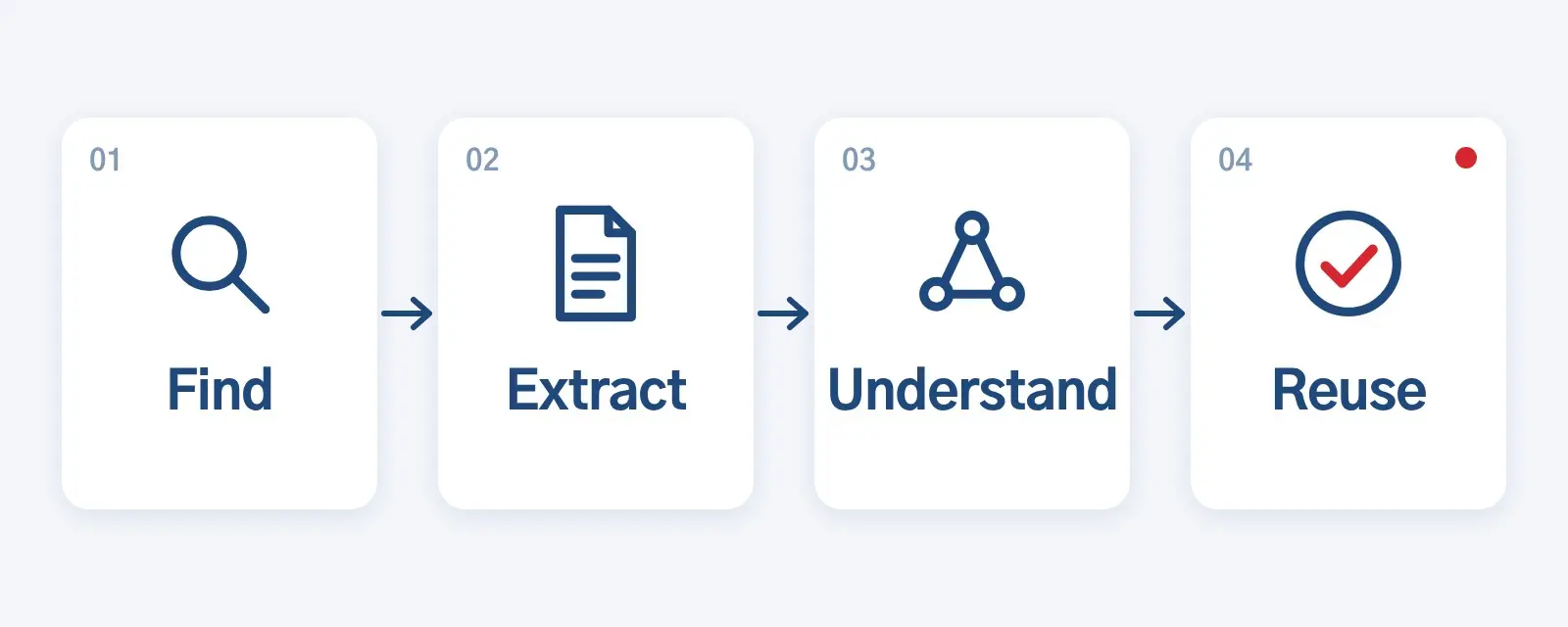
Information is AI-ready when AI can:
- Find it. It’s published where AI tools can reach it, not locked in a scan or behind a login it doesn’t need.
- Extract it. Its content and structure come out intact, including tables, headings and references.
- Understand it. Key facts are stated plainly, with clear headings and structured data that says what each thing is.
- Reuse it accurately. There’s one current version, so any answer can point back to the right source.
Measure what AI says
You can’t see inside the model, so you have to test it from the outside. We work out what people are likely to ask AI about an organisation, put those questions to the major platforms every month, and compare the answers with the facts.
Documents need the same treatment. The Victorian Law Reform Commission holds 25 years of law reform in PDFs. We’re making those reports machine-readable and searchable on the web, with people reviewing anything the system flags.
Where to start
Three questions will help you assess how ready your information is:
- Which documents or pages do people ask about most?
- If you ask an AI tool about them today, is the answer right?
- If it’s wrong, who in your organisation would know, and who is responsible for fixing it?
Many organisations haven’t asked these questions yet. The ones that ask early will shape the answers AI gives about them.
Komosion is an independent AI consultancy: education, implementation and the platforms AI depends on. Talk to us →
Related: AI did two days’ work in half a day. That was the easy part.