

There are no veterans in AI. Nobody has 10 years’ experience putting AI agents to work in an organisation, because the work didn’t exist 10 years ago.
We are all learning new ways of working and how to work with one of the most powerful technologies the world has ever known.
That reinforced our decision two years ago to establish what we call our AI Education Lab, bringing master’s and fourth-year students into our business in teams via university partnerships to learn and share their knowledge facing real-world challenges.
We run these programs with Swinburne University of Technology in Melbourne and have just finished our first 26-week capstone project with an RMIT Vietnam team.
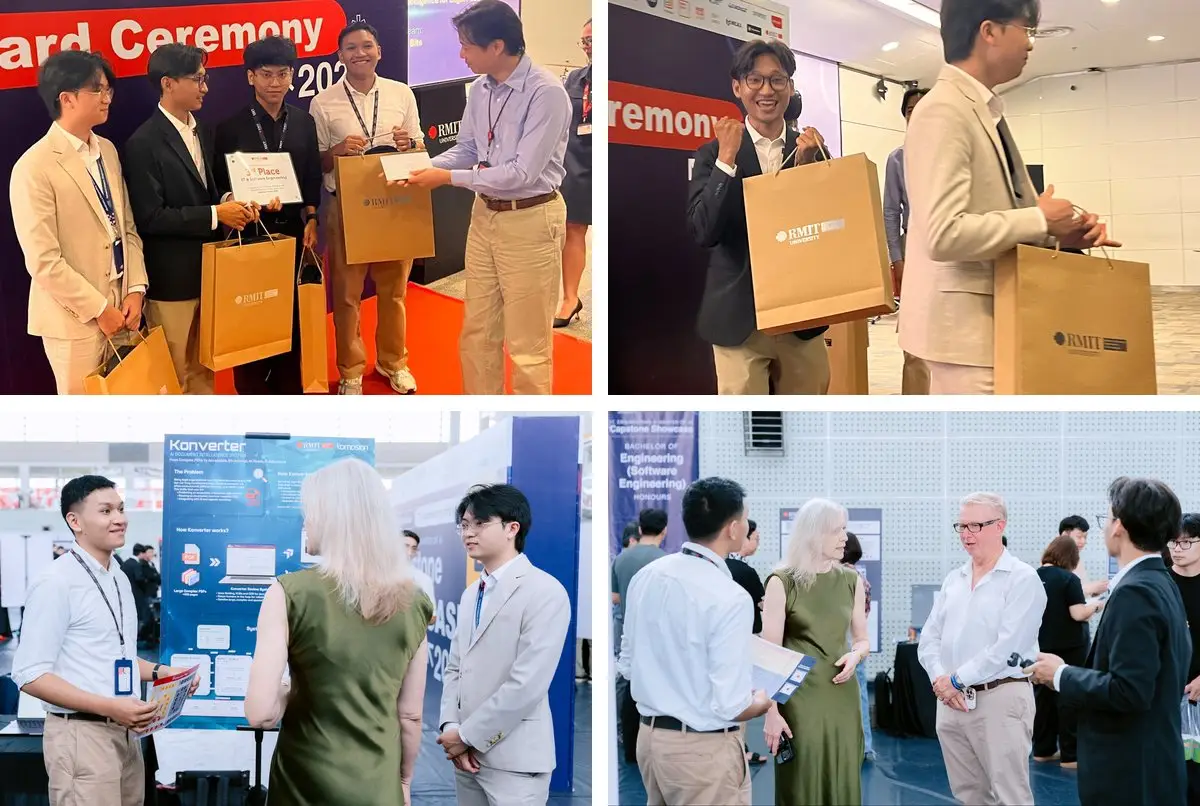
I was at RMIT Vietnam last month to celebrate with our team when our Konverter project placed third out of more than 40 IT and Engineering projects at the university’s 2026 Capstone Award Ceremony.
A real client, not a classroom brief
The Victorian Law Reform Commission has been a Komosion client for more than a decade. It holds 25 years of law reform in dense PDFs. They’re published online, but they’re hard to search and it’s a daunting archive to navigate.
Over 26 weeks, four students worked alongside our team to build a pipeline that optimises those reports so machines can accurately discover, extract, understand and reuse what’s in them. When AI answers a question from the archive, it cites its source and is designed to stay within it, with people reviewing anything the system flags.
Each student owned part of the build:
- Aung Su Pyae worked on the review workflow and accessible output
- Yethu Aung helped design the AI and machine learning components
- Linn Htin Nyo supported the infrastructure, security and audit protocols
- Zyle Estacion championed document ingestion and evaluation
Professor Iwona Miliszewska, Dean of RMIT Vietnam’s School of Science, Engineering & Technology, visited the Konverter stand at the Capstone Showcase on campus on 17 September, where the judging took place anonymously. Dr Quang Tran, Deputy Head of the Department of Artificial Intelligence, worked closely with the team throughout.
“This is the first time I’ve seen a capstone project with students getting this close to commercialisation,” Dr Tran told the team.
What comes next
Many capstone projects end with the presentation, but this one hasn’t. Yethu, Linn and Zyle are now on an intern-to-work pathway with Komosion.
And we’re now testing whether there’s a bigger market for Konverter. After all, the same problem exists at a very large scale across government, law, education and many other industries.
Read next: Your information was written for people. Now AI has to read it too.
See RMIT Vietnam’s photos from the Capstone Showcase and Award Ceremony