

Most organisations now pay for at least one AI tool. Far fewer can point to what it has changed. The gap isn’t the technology. It’s the work around it.
Walk through most mid-sized Australian organisations and you’ll find AI already on the books. Microsoft Copilot sits inside Microsoft 365. Someone has a ChatGPT account. A few people use Claude or Gemini on the side. The licences are paid every month.
Ask what it has changed, and the answers get vague. Some emails are quicker to write. A few meeting summaries. Nothing the board would call a result.
This isn’t a local problem. In 2025, MIT’s NANDA initiative studied how organisations use generative AI and found 95% were getting no measurable return. More than 80% had piloted tools such as ChatGPT or Copilot, but only about 40% had put them into use. The researchers’ conclusion: the problem isn’t the quality of the models. It’s how organisations put them to work.
A licence isn’t a result
Buying AI is the easy part. A licence gives each person a capable assistant, but it doesn’t change how the work flows. Reports still pass through the same hands. Approvals still wait in the same inboxes.
The value shows up when a specific piece of work is redesigned with AI built in. That takes implementation, not just adoption.
Start with the work, not the tool
The first question isn’t “Copilot, ChatGPT, Claude or Gemini?” Each is capable, and most organisations already own at least one. If you run Microsoft 365, Copilot is probably the AI you already pay for.
The better question is: which piece of work costs us the most time, causes the most rework, or holds up a decision? Pick one. Map how it’s done today. Then decide what AI should do, what people should still do, and what has to change around it.
The MIT research points the same way. The biggest returns came from back-office work such as finance, operations and document handling, even though most AI budgets went to sales and marketing.
An example from our own business
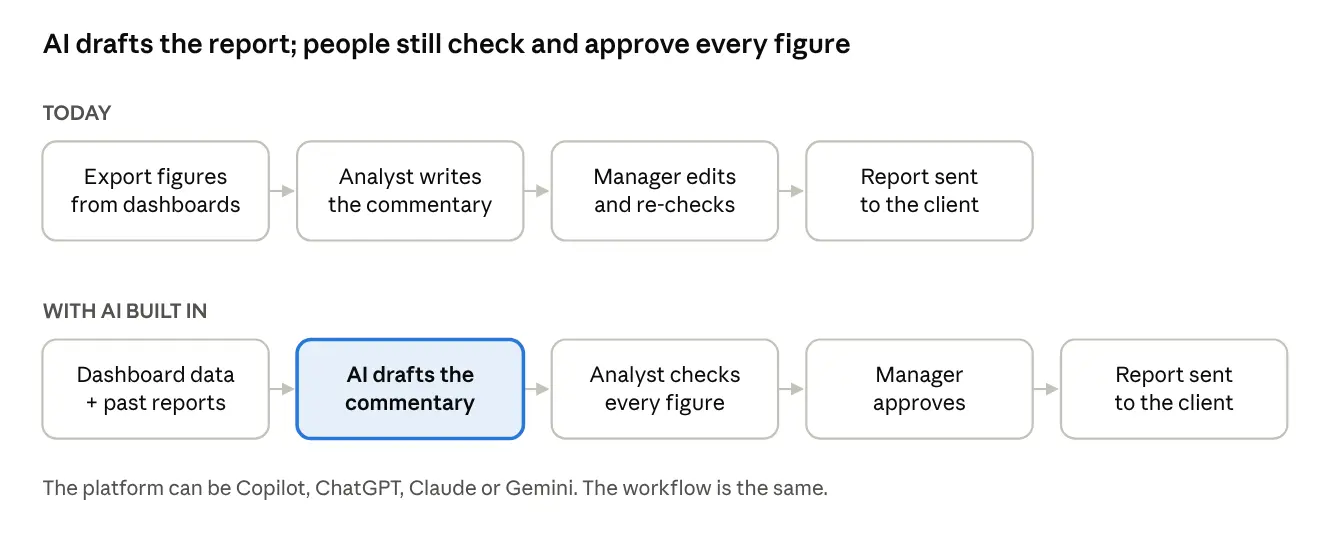
Every month our team turns dashboard figures into a report for clients. Until now an analyst exported the numbers, wrote the commentary, and a manager edited and re-checked it. We’re now building a version where AI drafts the commentary from the data and past reports. The analyst checks every figure, the manager approves, and the client gets a report they can read in plain English. The AI does the first draft. People stay accountable for every number.
What matters more than the platform
- The right workflow. Frequent, time-consuming and easy to measure.
- Information in order. AI can only use what it can find and read. (Is your information ready for AI?)
- Redesigned steps. Who checks what, where a person approves, and what happens when the AI isn’t sure.
- People learning as they go. Training on their own work, not a generic course.
Get these right and the same workflow will run on any of the major platforms.
Efficiency first, then effectiveness
Most organisations should start with efficiency: saving hours on a task people already do. It’s easy to measure, it builds confidence and it earns trust.
Once a team trusts the result, a better question follows. Not just “how do we do this faster?” but “how do we do this better?” That’s where the larger gains are.
What comes next: your rules, written once
Once the first workflow works, the next step is often to turn your own business rules into a reusable skill that AI applies the same way every time.
We’re doing this with our own sales process. The criteria we use to judge a new opportunity are being written into a skill. It gathers the evidence, applies the criteria and separates what’s known from what’s assumed. It flags missing information rather than counting it against the opportunity, and it offers options rather than a verdict. The decision stays with a person.
The answer is rarely AI alone
AI is now part of almost every answer, but rarely the whole of it. Komosion is an independent, technology-neutral AI consultancy. We help you get measurable value from the AI you already own, add specialist tools only where they earn their place, build what the platforms can’t, and keep improving the result.
Not sure where to start? Our AI Planning Workshop finds the one or two workflows worth changing first, and what it will take to change them. Talk to us →
Frequently asked questions
Which AI platform should we use?
Usually the one you already pay for. Copilot, ChatGPT, Claude and Gemini are all capable. The workflow and the information behind it matter more than the platform.
We already have Microsoft Copilot. Why aren’t we seeing results?
A licence gives each person an assistant but doesn’t change how the work flows. Results come when a specific workflow is redesigned with AI built in, and people are trained on that work.
Where should we start?
With one workflow that is frequent, time-consuming and easy to measure. Efficiency gains on a task people already do build confidence for bigger changes.
Do we need to buy more AI tools?
Not usually. Most organisations can get measurable value from what they already own. Specialist tools are worth adding only when a workflow needs something the platforms can’t do.
What does Komosion do?
Komosion is an independent, technology-neutral AI consultancy. We advise, implement and improve: finding the workflows worth changing, building AI into them, and improving them over time.