

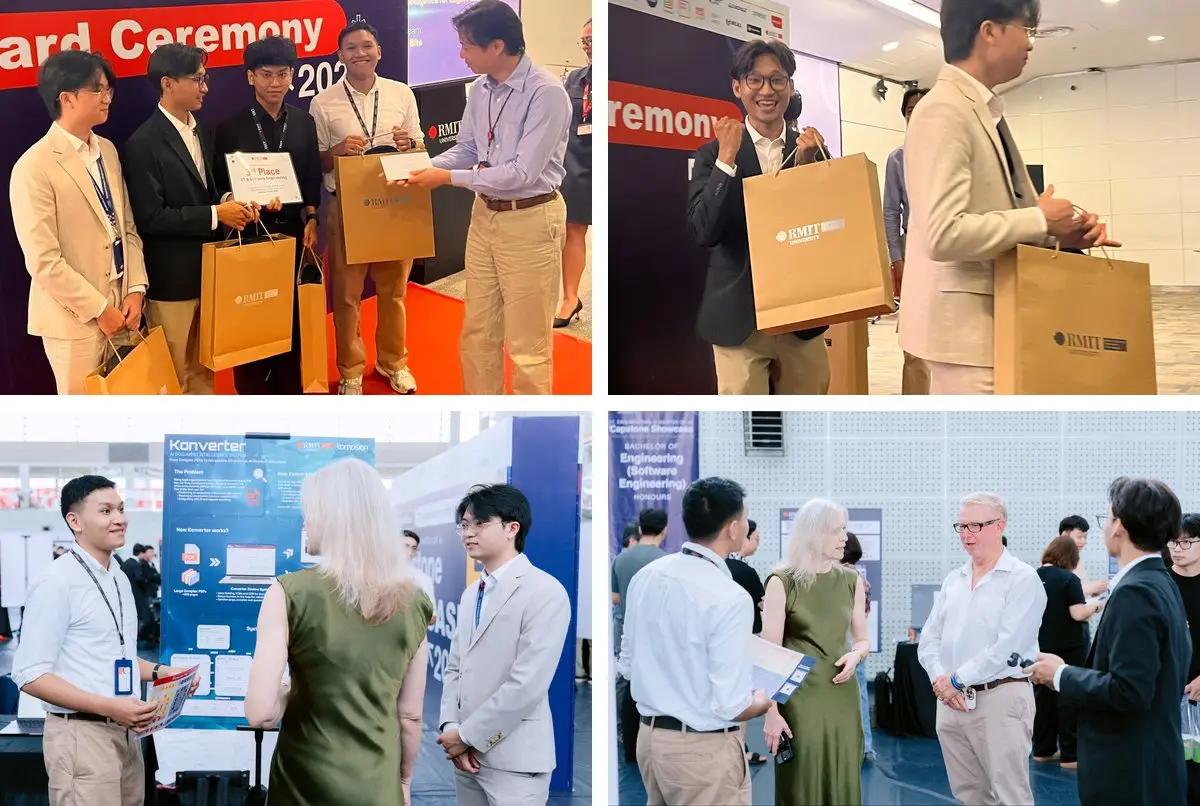
Our work making the Victorian Law Reform Commission’s reports machine-readable and web-searchable started life as an RMIT Vietnam capstone project, Konverter. On 17 September, the four students who helped build it with our Ho Chi Minh City team placed third out of more than 40 IT and Engineering projects at RMIT Vietnam’s 2026 Capstone Award Ceremony.
A real client problem
The Victorian Law Reform Commission has 25 years of law reform locked in dense PDFs. They’re published online, but they’re hard to search and AI tools can’t use them.
Over 26 weeks, working side by side with our team, the students built a pipeline that faithfully converts those PDFs into accessible web pages and machine-readable content that AI can search and answer questions from. People review anything the system flags before it is published.
The team
Each student owned part of the build:
- Aung Su Pyae: the review workflow and accessible output
- Yethu Aung: AI and machine learning
- Linn Htin Nyo: infrastructure, security and audit
- Zyle Estacion: document ingestion and evaluation
Professor Iwona Miliszewska, Dean of RMIT Vietnam’s School of Science, Engineering & Technology, visited the Konverter stand at the showcase. Dr Quang Tran, Deputy Head of the Department of Artificial Intelligence, worked closely with the team throughout the project.
This is the first time I’ve seen a capstone project with students getting this close to commercialisation.
Dr Quang Tran, Deputy Head, Department of Artificial Intelligence, RMIT Vietnam
What comes next
Yethu, Linn and Zyle are now joining us as interns while they finish their studies. It’s the first step in an intern-to-work pathway we’re building into our talent pipeline.
We’re also testing whether this approach has a market beyond the VLRC, including in Vietnamese and other languages. The problem it solves exists across government, law, education and many other industries. Read why your information now has to work for AI as well as people.
See RMIT Vietnam’s photos from the Capstone Showcase and Award Ceremony.